AI Chatbots: What Local Businesses Get Wrong

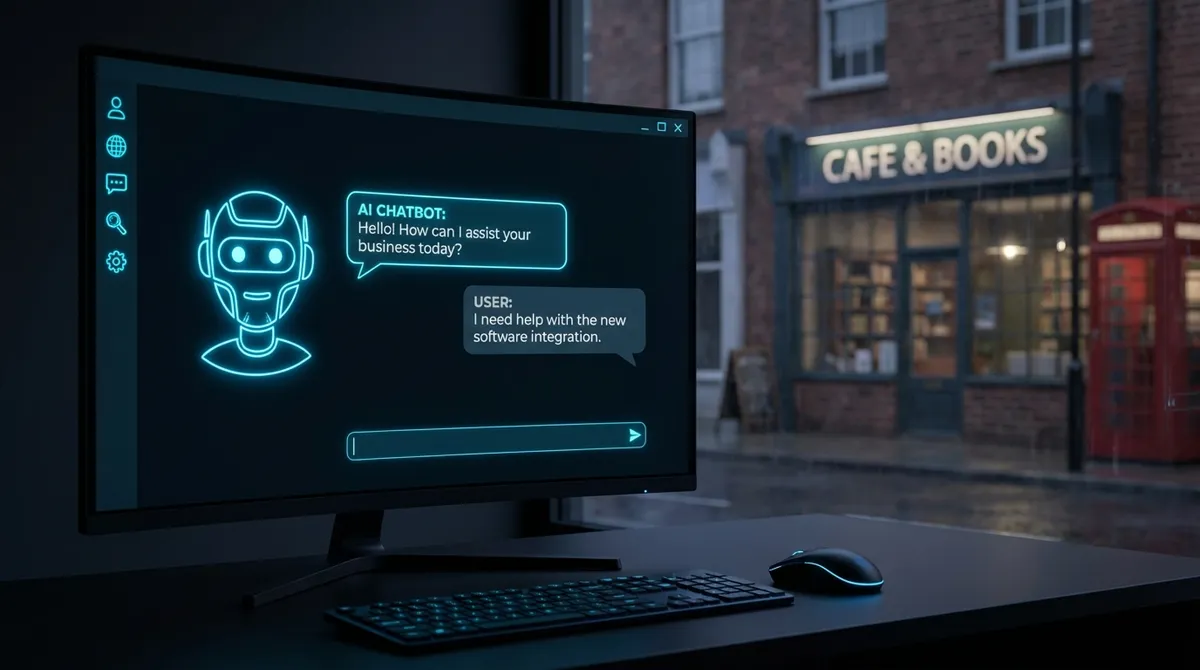
We have all been trapped in a terrible chatbot. The ones that loop you through menus, never understand what you are asking, and eventually spit out "please contact us during business hours." They make customers angry, not loyal.
But a well-built AI chatbot is a different thing entirely. And for local businesses in Stoke-on-Trent and Staffordshire, it can be a genuine competitive advantage.
Key Takeaways
- Most small business chatbots fail because they rely on keyword matching, not genuine language understanding — the gap between old and new AI is enormous
- A properly built AI chatbot answers from your actual data, understands context, and knows when to escalate to a human
- The biggest mistake is treating a chatbot as a cost-cutting tool rather than a customer experience improvement
- Integration with your real systems — booking, CRM, stock — is what separates useful from useless
- For Staffordshire businesses, a 24/7 AI chatbot is a direct competitive edge over anyone who goes dark after 5pm
What a Good AI Chatbot Does
A properly built AI chatbot, powered by a model like Claude, can:
- Understand natural language - not just keywords. Customers type like humans, and the chatbot responds like one.
- Answer questions from your actual data - trained on your FAQs, pricing, service areas, policies. Not generic rubbish.
- Know when to hand off - the best chatbots know their limits. Complex queries get routed to a human with full context, so the customer never has to repeat themselves.
- Work 24/7 - your business answers enquiries at 2am on a Sunday. Your competitors do not.
Why the Current Generation Is Different
If your experience with chatbots is the old keyword-matching variety, you need to reset your expectations. The current generation, powered by large language models, operates on a fundamentally different level.
Old chatbots worked like decision trees. If the customer typed a keyword, the bot followed a pre-programmed branch. If the customer used the wrong word, the bot got lost. It was like navigating a phone menu with a keyboard.
Modern AI chatbots understand meaning. A customer can type "I paid you last week but the invoice still says outstanding" and the chatbot understands that this is a payment reconciliation query. It can pull up the relevant account, check the payment status, and give a useful answer. Or, if the issue requires human intervention, it routes the conversation to your team with the full context attached.
That is a completely different product. And it changes the economics of customer service for small businesses.
What Most Businesses Get Wrong
Buying off-the-shelf
Generic chatbot platforms give you generic results. They do not know your business, your tone of voice, or your customers. A chatbot that sounds like every other chatbot is not a competitive advantage. It is a nuisance.
I have seen businesses in Stoke-on-Trent install plug-and-play chatbot widgets that greet customers with American English, reference US business hours, and offer support for products the company does not even sell. The customer experience is worse than having no chatbot at all. You are actively damaging your brand.
A chatbot needs to sound like your business. If your brand is friendly and informal, the chatbot should be too. If you are a professional services firm, the tone should reflect that. If you are a Staffordshire business serving Staffordshire customers, it should know local terminology and context.
Trying to replace humans entirely
Chatbots handle the volume. Humans handle the complexity. The goal is not to remove your team from customer service. It is to let them focus on the conversations that actually matter.
A good rule of thumb: if a query has a factual, consistent answer, a chatbot should handle it. Opening hours. Pricing. Service areas. Return policies. Booking processes. These are high-volume, low-complexity interactions that eat up your team's time.
But if a customer is upset, confused about something specific to their account, or has a request that requires judgement, a human should handle it. The chatbot's job in these cases is to capture the context and hand off cleanly. "I have passed your question to our team along with your account details. Someone will be in touch within the hour." That is a good handoff.
Ignoring the data
Every chatbot conversation is data. What are customers asking? Where do they get stuck? What questions come up that you have not addressed on your website? A good chatbot setup feeds this intelligence back to you.
This is one of the most valuable and most overlooked aspects of running an AI chatbot. After a month of operation, you have a complete picture of what your customers actually want to know. You will find gaps in your website content, misunderstandings about your pricing, and questions you never anticipated. That data is gold. It informs your marketing, your service design, and your content strategy.
We build analytics dashboards alongside every chatbot we deploy, so you can see this data at a glance. Not buried in a spreadsheet. Visible, actionable, and updated in real time.
How We Build Them
At Denton Dynamics, we build AI chatbots that are trained on your specific business data. We use retrieval-augmented generation (RAG) so the chatbot pulls answers from your actual content, not hallucinated nonsense.
The Technical Architecture
Here is what a properly built chatbot system looks like under the hood:
Knowledge base. We take your website content, FAQs, policy documents, pricing sheets, and any other relevant information, and process it into a structured knowledge base. This is what the chatbot draws from when answering questions.
Retrieval layer. When a customer asks a question, the system searches the knowledge base for the most relevant information. This is the "retrieval" part of RAG. It ensures the chatbot is answering based on your actual data, not making things up.
Generation layer. The AI model (we use Claude for most projects) takes the retrieved information and generates a natural, conversational response. It adapts the answer to the specific question rather than just pasting in a pre-written response.
Handoff logic. We define rules for when the chatbot should escalate to a human. This can be based on the topic (complaints always go to a person), the customer's sentiment (if they seem frustrated, escalate), or the chatbot's confidence level (if it is not sure of the answer, hand off rather than guess).
Integration. The chatbot connects to your existing systems. It can check order status, look up account information, or create support tickets in your CRM. It is not a standalone widget. It is part of your infrastructure.
Deployment
We deploy chatbots as part of your existing website, built with Next.js for speed and reliability, and hosted on Vercel for consistent uptime. The chatbot loads fast, works on mobile, and does not slow down your page. We set up monitoring so you can see exactly how the chatbot is performing and where it needs improvement.
Training the Chatbot Properly
The biggest factor in chatbot quality is the training data. Feed it rubbish, you get rubbish back. Feed it well-structured, comprehensive information about your business, and you get a chatbot that knows its stuff.
What Good Training Data Looks Like
- Comprehensive FAQs. Not five questions. Fifty. A hundred. Every question your team gets asked regularly, with a thorough answer.
- Process documentation. How does your quoting process work? What happens after a customer places an order? What is your returns policy? The more the chatbot knows about your processes, the more useful it is.
- Tone and brand guidelines. We give the chatbot examples of how your business communicates. Real emails, real responses, real language. This shapes how it talks to customers.
- Boundary definitions. What should the chatbot never promise? What topics are off-limits? What claims should it not make? Defining the edges is as important as defining the centre.
Ongoing Training
The initial training is just the start. As the chatbot handles real conversations, we identify gaps and update the knowledge base. New products, pricing changes, seasonal variations, these all get incorporated. A chatbot that is not updated is a chatbot that slowly becomes inaccurate.
Use Cases Beyond Customer Support
While customer service is the obvious use case, AI chatbots can do a lot more:
Internal Knowledge Bots
Your team has questions too. "What is our policy on X?" "Where is the template for Y?" "How do we process Z?" An internal chatbot trained on your company documentation can answer these instantly, reducing the time people spend searching for information or asking colleagues.
Lead Qualification
A chatbot on your website can do more than answer questions. It can qualify leads. "What service are you interested in? What is your timeline? What is your approximate budget?" By gathering this information conversationally, the chatbot filters enquiries and passes qualified leads to your sales engine with context attached.
Appointment Booking
For service businesses in Stoke-on-Trent that rely on bookings, a chatbot can handle the scheduling conversation. "I would like to book a consultation." "Certainly. We have availability on Tuesday at 10am or Thursday at 2pm. Which works for you?" Connected to your calendar system, the chatbot books the appointment and sends a confirmation. No phone tag required.
Onboarding New Clients
When a new client signs up, there is always a list of things they need to know and forms they need to complete. A chatbot can guide them through the onboarding process step by step, collecting information and answering questions along the way. It reduces the admin load on your team and gives the new client a smooth, professional experience.
The Business Case
A single customer service hire costs upwards of £25,000 per year. An AI chatbot that handles 60-70% of incoming queries costs a fraction of that and never calls in sick. For small businesses across Staffordshire, that maths is hard to ignore.
But it is not just about cost replacement. It is about capability expansion. Without a chatbot, your business can only answer queries during office hours. With one, you are available around the clock. Without a chatbot, your response time depends on who is in the office. With one, every query gets a response in seconds. Without a chatbot, scaling customer service means hiring. With one, scaling means adding to the knowledge base.
A Practical Example
A trade business in Staffordshire gets around 40 enquiries per week through their website. Before the chatbot, maybe 15 of those got a reply within an hour. The rest waited until someone had time. After deploying a chatbot, all 40 get an immediate, personalised response. The ones that need human attention are flagged and prioritised. Conversion rate on enquiries went up because people were getting fast, relevant answers.
That is the difference. Not replacing your team. Extending your team's reach.
What It Costs
We price chatbot projects based on complexity. A straightforward customer service chatbot with a moderate knowledge base, standard handoff logic, and website integration is a fixed-fee project. More complex implementations with multi-system integration, custom dashboards, and advanced routing cost more, but the ROI scales accordingly.
We are transparent about pricing. We will tell you upfront what it will cost and what you can expect in return. No hidden fees, no surprise invoices.
If you want a chatbot that actually works, not one that makes your customers want to throw their phone, let us build it.
Nate Denton
CEO, Denton Dynamics
Nate is the founder and CEO of Denton Dynamics, an AI consultancy and software development agency in Stoke-on-Trent. He has been building AI automation systems, bespoke software, and SEO strategies for UK businesses since 2022. Every article on this blog comes from direct implementation experience. Read his full profile.
Trending
Related post
Expand your knowledge with these hand-picked posts.
AI Integration Services: What They Are and Why You Need Them
AI integration services connect your disconnected business tools into one automated workflow. Here is what that means in practice.
Nate Denton - CEO, Denton Dynamics
Business Process Automation: A Practical Guide for SMEs
Business process automation removes repetitive manual work. Here is how SMEs are using it, what to automate first, and how to get started.
Nate Denton - CEO, Denton Dynamics


Ready to Build Something That Actually Works?
We build real systems. AI automation, bespoke apps, websites that rank, and sales engines that run while you sleep. Book a call and let's talk.