

What Bespoke AI Development Actually Looks Like

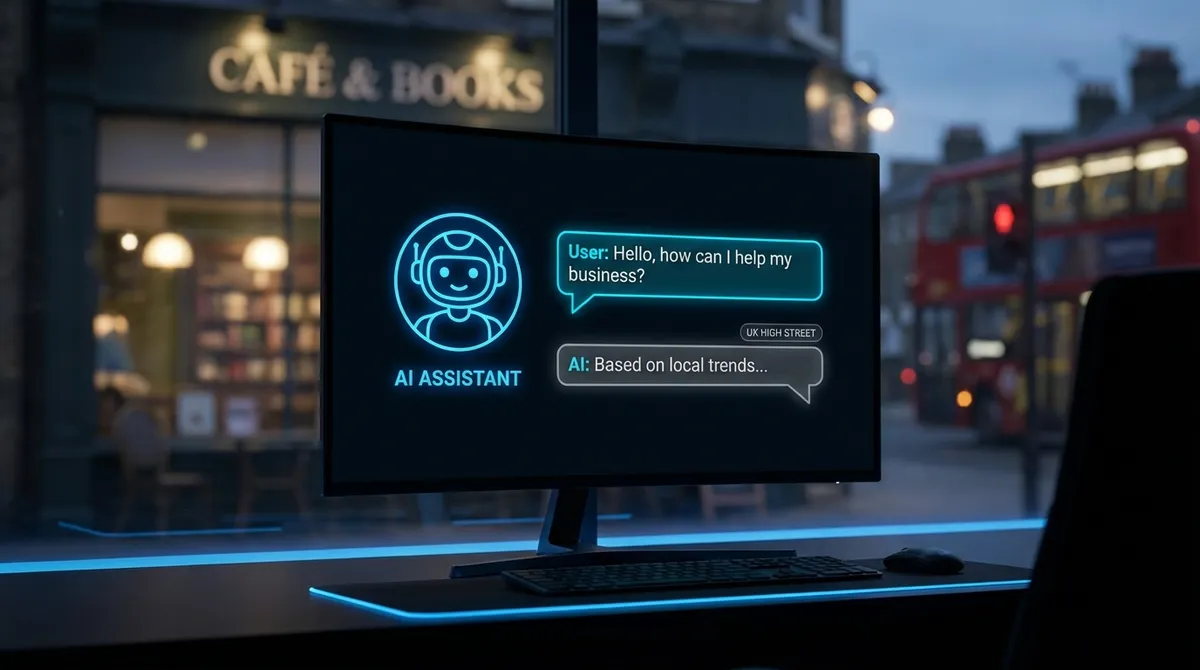
"Custom AI development" sounds expensive and complicated. It does not have to be either. But it does need to be done properly. Here is what the process actually looks like when we build something for a business in Stoke-on-Trent or the wider Staffordshire area.
Key Takeaways
- Custom AI development starts with the problem, not the technology — the discovery phase is where most of the value is created
- Most businesses already know what is costing them time and money; they just have not had anyone turn that pain into a technical solution
- Mapping your workflow end-to-end usually reveals that the bottleneck is not where you thought it was
- We build in phases — small, testable increments rather than one large system that takes months to deliver and may not fit when it arrives
- A well-specified AI system should be maintainable and explainable — if the agency cannot hand it over with documentation, it is a liability, not an asset
Step 1: Understand the Problem
We do not start with technology. We start with the problem. What is costing you time? What is costing you money? What keeps falling through the cracks?
Most businesses already know the answer. They just have not had anyone turn that pain into a solution before.
This is the step most agencies skip or rush through. They come in with a product they want to sell and work backwards to make it seem like it fits. We do the opposite. We sit down, listen, and ask uncomfortable questions. How many leads did you lose last month? What does your team spend their first hour on every morning? Where does information get stuck?
The answers usually surprise people. Not because the problems are hidden, but because nobody has ever quantified them before. When you realise your team spends eleven hours a week re-typing data from emails into a spreadsheet, the case for automation writes itself.
Real Problems We Have Solved
A property management company in Stoke-on-Trent was drowning in tenant enquiries. Their team spent half the day answering the same questions about maintenance schedules, payment dates, and tenancy agreements. We built an AI chatbot trained on their specific documentation that handled 70% of incoming queries without human involvement. The team got their afternoons back.
A manufacturing supplier in Staffordshire needed to process incoming purchase orders from dozens of customers, all in different formats. PDFs, emails, spreadsheets, even photos of handwritten forms. We built an AI pipeline that reads these documents, extracts the relevant data, and populates their order management system. What took a full-time admin role now runs automatically.
These are not hypothetical scenarios. These are the kinds of problems that exist in businesses all over Stoke-on-Trent and Staffordshire. You probably have your own version.
Step 2: Map the Workflow
Before writing a single line of code, we map out how things currently work. Every step, every handoff, every manual touchpoint. This is where the real insights come from. You often find the bottleneck is not where you think it is.
We usually do this in a collaborative session. We draw the process end to end, mark every decision point, and identify where information changes hands. It looks simple on a whiteboard, but it reveals things that are invisible when you are inside the process every day.
Where the Waste Hides
There are patterns we see in almost every business:
Double handling. The same data gets entered into two or three systems because they do not talk to each other. A customer name goes into the CRM, then gets typed again into the invoicing tool, then again into the project management app.
Approval bottlenecks. Everything flows smoothly until it needs sign-off from one person who is in meetings all day. The process stalls, not because the work is hard, but because the routing is broken.
Manual translation. Information arrives in one format and needs to be converted to another. A customer sends an email with their requirements, and someone has to turn that into a structured brief. That is exactly the kind of task AI handles well.
Knowledge silos. One person knows how to do something, and when they are on holiday, it does not get done. A well-documented AI system encodes that knowledge so it is available to the whole team.
Step 3: Design the Solution
This is where AI comes in. We figure out which parts of the workflow can be handled by:
- Large language models (like Claude) for understanding text, generating responses, summarising documents
- Automation pipelines for moving data between systems without human intervention
- Custom dashboards built in Next.js and deployed on Vercel for real-time visibility
The key is only using AI where it adds genuine value. Not everything needs a neural network. Sometimes a well-designed automation is the right answer. Sometimes a simple webhook connecting two systems does the job.
Choosing the Right Tool for Each Part
This is where experience matters. An inexperienced team will try to use AI for everything because it is new and exciting. A team that has built dozens of these systems knows that the best solutions use the simplest effective tool at each step.
Need to move data from System A to System B when an event fires? That is a webhook and an n8n workflow. No AI needed.
Need to understand the intent behind a free-text customer message and route it to the right department? That is a language model.
Need to generate a personalised quote based on a customer's requirements? That is an AI model pulling from your pricing data and drafting a document.
Need to show your team a real-time view of what is happening? That is a Next.js dashboard deployed on Vercel, pulling from the same data pipeline.
The design phase produces a blueprint. You see exactly what will be built, what each component does, and how they connect. No surprises later.
Step 4: Build and Ship
We build fast. Most projects go from first conversation to working prototype in two to three weeks. We use modern tools because they let us move quickly without cutting corners on quality.
Next.js for the frontend. It handles server-side rendering, API routes, and static pages in a single framework. This means your AI system has a professional, fast interface that works on any device.
Vercel for deployment. Zero-downtime deploys, automatic scaling, global CDN. Your system stays fast and reliable without you needing a DevOps team.
Serverless architecture so you pay for what you use. If the AI processes a hundred requests a day or ten thousand, the infrastructure scales accordingly.
n8n for workflow orchestration. When systems need to talk to each other, n8n handles the plumbing. It is reliable, extensible, and easy to monitor.
You get a staging environment to test. You give feedback. We iterate. Nothing goes live until you are happy with it.
How the Build Works in Practice
We work in focused sprints. First week, the core functionality is up and running. You can see it, interact with it, and start forming opinions. Second week, refinements based on your feedback, edge case handling, and integration with your existing tools. Third week, final testing, monitoring setup, and deployment to production.
Throughout this process, you have access to a preview environment. You can share it with your team, try to break it, and tell us what does not feel right. We would rather hear "this is wrong" in week one than in month three.
Step 5: Monitor and Improve
Software is not a one-and-done project. We set up monitoring so you can see how your AI is performing. How many queries it handles, where it gets stuck, what customers are actually asking. Then we tune it.
This is where custom AI really separates itself from off-the-shelf tools. A generic chatbot does not improve over time because nobody is watching it. A custom system has monitoring built in from day one.
What We Track
Response accuracy. Is the AI giving correct answers? We log interactions and review edge cases so we can refine the system's knowledge base.
Processing speed. How long does each step in the pipeline take? If a step is slower than it should be, we optimise it.
User satisfaction. Are customers engaging with the AI or abandoning it? High abandonment rates tell us something needs to change.
Error rates. When the AI does not know the answer or encounters an unexpected input, how does it handle it? We track these cases and teach the system to deal with them.
Continuous Improvement
Every month, we review the data and make adjustments. Maybe customers are asking a type of question the chatbot was not trained for. We update the knowledge base. Maybe a particular automation step fails on edge cases. We add handling for those cases. The system gets better with use, which is the entire point.
Why Stoke-on-Trent Businesses Need This
The Potteries has always been a place that makes things. That spirit applies to software too. You do not need to outsource your AI to London or Manchester. Denton Dynamics builds right here, for businesses that operate right here.
There is something practical about working with a local team too. We can be in your office in twenty minutes. We understand the local market. We know that a solution for a Stoke-on-Trent business needs to be practical, robust, and cost-effective. Not a shiny demo. Not a concept that works in theory. Something your team actually uses every day.
The Staffordshire Tech Scene
Something that often surprises people is how much technical talent exists in Staffordshire. Keele and Staffordshire Universities produce strong graduates. There are software companies, digital agencies, and tech startups throughout the region. Denton Dynamics is part of that ecosystem, and we are proving that world-class AI development does not require a London postcode.
What Happens After Launch
A question we always get: "What happens once it is built?" The answer is straightforward. We provide ongoing support. If something breaks at 10pm on a Tuesday, we fix it. If your business changes and the system needs updating, we update it. If you want to add a new automation or extend the AI's capabilities, we build it.
Bespoke software is a living system. It evolves with your business. That is the whole point of building custom rather than buying generic.
If you want AI that actually fits your business, not a demo that looks good in a pitch deck, get in touch.
Nate Denton
CEO, Denton Dynamics
Nate is the founder and CEO of Denton Dynamics, an AI consultancy and software development agency in Stoke-on-Trent. He has been building AI automation systems, bespoke software, and SEO strategies for UK businesses since 2022. Every article on this blog comes from direct implementation experience. Read his full profile.
Trending
Related post
Expand your knowledge with these hand-picked posts.
AI Integration Services: What They Are and Why You Need Them
AI integration services connect your disconnected business tools into one automated workflow. Here is what that means in practice.
Nate Denton - CEO, Denton Dynamics
Business Process Automation: A Practical Guide for SMEs
Business process automation removes repetitive manual work. Here is how SMEs are using it, what to automate first, and how to get started.
Nate Denton - CEO, Denton Dynamics


Ready to Build Something That Actually Works?
We build real systems. AI automation, bespoke apps, websites that rank, and sales engines that run while you sleep. Book a call and let's talk.