
Why Staffordshire SMEs Should Use AI Now

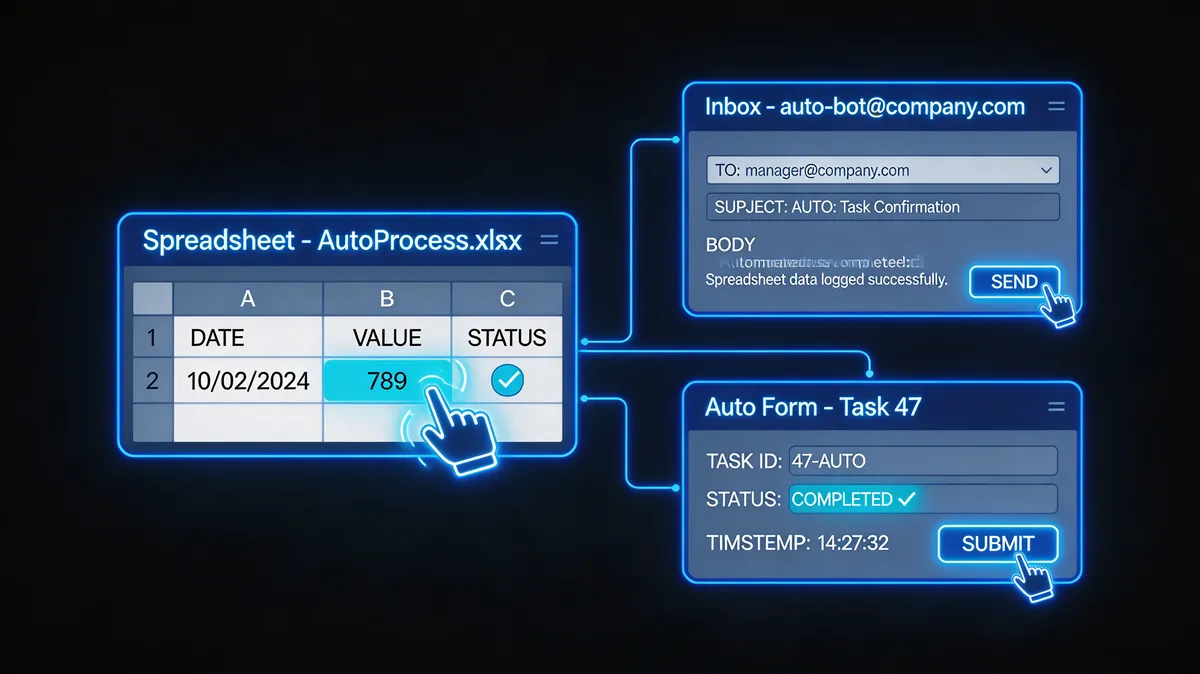
Most small businesses in Staffordshire are still running on spreadsheets, manual follow-ups, and gut feeling. That worked fine ten years ago. It does not work now.
Key Takeaways
- AI adoption gives early movers a compounding advantage — the businesses that start now will be significantly harder to catch in two years
- For SMEs, AI is not about replacing staff — it is about giving a small team the output capacity of a much larger one
- The highest-value use cases for most Staffordshire businesses are customer enquiry handling, lead follow-up, and automating admin
- The cost of AI tools has dropped dramatically — the barrier is no longer budget, it is knowing where to start
- Local knowledge combined with AI capability is a genuine competitive moat that larger national competitors cannot easily replicate
The Gap Is Widening
Your competitors, even the ones down the road in Stoke-on-Trent, are starting to use AI tools to handle the boring stuff. Lead follow-up, customer queries, invoice chasing, content creation. The businesses that adopt early get a compounding advantage. The ones that wait get left behind.
This is not about replacing people. It is about giving your team superpowers.
And the gap is not theoretical. A service business that responds to enquiries within two minutes converts at a dramatically higher rate than one that takes five hours. An e-commerce brand that personalises product recommendations sees higher basket values. A trade company that automates its quoting process handles three times the volume without hiring. These are real outcomes, happening right now, in businesses no bigger than yours.
What AI Actually Does for a Small Business
Forget the hype. Here is what AI software does in practice for an SME:
- Answers customer questions 24/7 - an AI chatbot handles the repetitive queries so your team can focus on the ones that actually need a human.
- Writes first drafts - blog posts, emails, social captions. AI gets you 80% there in seconds. You polish the last 20%.
- Spots patterns in your data - which leads convert, which customers are about to churn, which products sell on Tuesdays. AI finds signals you would miss.
- Automates admin - scheduling, data entry, report generation. The stuff nobody wants to do but everyone has to.
But those are just the starting points. Let me get more specific, because vague lists are easy to ignore.
Customer Enquiry Handling
Picture this. You run a plumbing business in Stoke-on-Trent. Between 6pm and 8am, your phone goes to voicemail. Every missed call is a potential job lost to the competitor who picked up. An AI chatbot on your website handles those after-hours enquiries, collects the details, books provisional slots, and sends you a summary first thing in the morning. You wake up with three new jobs instead of three missed calls.
Quoting and Proposals
If you are sending quotes manually, typing up the same information in slightly different formats for every customer, that is hours of your week gone. AI can pull from your pricing data, read the enquiry context, and draft a professional quote in seconds. You review it, tweak the numbers if needed, and send. What used to take 45 minutes takes five.
Content and Marketing
Most small businesses know they should be posting on social media, writing blog posts, and sending email newsletters. Most of them do not have time. AI tools like Claude can draft content that sounds like you, not like a robot. Give it your tone, your key messages, and your audience, and it produces content you can publish the same day. It is not going to win a Pulitzer, but it keeps your brand visible while you focus on the work that pays the bills.
Bookkeeping and Invoicing
AI can read incoming invoices, extract amounts and dates, categorise expenses, and flag anything unusual. Paired with an automation pipeline, your bookkeeping can run itself for the routine stuff, with exceptions surfaced to you for manual review.
Why Local Matters
A lot of agencies will sell you a generic AI chatbot or an off-the-shelf automation. It works until it does not. When your business has specific processes, specific customer expectations, and specific quirks, you need something built for you.
That is what we do at Denton Dynamics. We build bespoke AI software for businesses in Stoke-on-Trent and across Staffordshire. Not templates. Not reskinned SaaS. Actual software that fits your workflow.
There is a practical reason local matters too. When we build for businesses in Staffordshire, we understand the market. We know the difference between a business serving Hanley town centre and one covering rural North Staffordshire. We know the customer expectations, the seasonal patterns, the competitive landscape. That context goes into the software.
Understanding Your Stack
Most SMEs in the area are running a combination of tools they have picked up over the years. Maybe Xero for accounting, a WordPress site, a Gmail inbox, and a paper diary. We do not rip all of that out. We connect it. An n8n automation can link your website contact form to your CRM, trigger a Telegram notification to your phone, and schedule a follow-up email, all without changing the tools you already know. That is practical AI. It meets you where you are.
The Cost Objection
"We cannot afford AI." You cannot afford not to use it. A single AI automation that saves your team two hours a day pays for itself inside a month. And unlike hiring, it scales without adding headcount.
Let me put some real numbers on this. Say you are paying someone £12 an hour for admin tasks. Two hours a day, five days a week, that is £120 a week. Over a year, that is £6,240 on tasks that an automation handles for a fraction of the cost. And that person can now spend those two hours on something that actually grows the business, answering the phone, closing deals, improving service quality.
The question is not whether you can afford AI. It is whether you can afford to keep paying humans to do robot work.
The Hidden Costs of Not Adopting
There are costs you do not see on a spreadsheet. The lead that went to your competitor because you took four hours to reply. The customer who left a bad review because their simple question went unanswered over a weekend. The hiring round you had to run because your admin assistant burned out on repetitive data entry. These are all fixable problems. AI fixes them.
Common Misconceptions
"AI is for big companies"
Wrong. Big companies have entire departments to handle the tasks AI automates. Small businesses do not. That means small businesses benefit more from AI on a per-person basis. When you have three staff and an AI tool saves each of them an hour a day, you have effectively added another part-time employee without the salary, the NI contributions, or the holiday cover.
"It is too complicated to set up"
It does not have to be. A well-built AI system is invisible to the people using it. They interact with the same tools they already use. The AI works behind the scenes, routing data, generating drafts, flagging exceptions. The complexity is in the build, not the use. That is our job, not yours.
"The technology is not ready yet"
The technology has been ready for over a year. Models like Claude can understand context, follow instructions, and generate useful output at a level that would have seemed impossible three years ago. The tools are mature. The infrastructure is reliable. The only thing that is not ready is the businesses still waiting on the sidelines.
Where to Start
You do not need to overhaul everything overnight. Pick one painful process, the thing your team complains about most, and automate it. See the results. Then do the next one.
Here is a practical starting framework:
- List your repeating tasks. Anything your team does more than five times a week that follows the same pattern is a candidate.
- Estimate the time cost. How many hours a week does each task consume? Multiply by your hourly cost.
- Rank by pain. Some tasks are not just time-consuming, they are demoralising. Start with the ones your team hates most. Quick wins build momentum.
- Build one automation. See the result. Measure the time saved. Then move to the next.
We have worked with businesses in Stoke-on-Trent and across Staffordshire that followed exactly this approach. Within three months, most of them have automated three or four processes and freed up enough hours to take on more work without hiring.
The Compound Effect
Here is what most people miss about AI adoption. Each individual automation seems small. Saving 30 minutes here, an hour there. But they compound. When your lead follow-up is automated, your quoting is faster, your customer queries are handled 24/7, and your content is flowing consistently, the cumulative effect is a business that operates at a level it could not reach before. Not because you hired ten more people, but because the three people you have are doing the work that only humans can do, while AI handles the rest.
Think about it this way. A business that automates lead capture responds faster than competitors. Faster response means higher conversion. Higher conversion means more revenue. More revenue means more capacity to invest in the next automation. Each improvement funds the next one, and the gap between you and the businesses that did not start widens every month.
This is already happening in Staffordshire. The businesses that moved early on AI are pulling ahead. Not because they are bigger or better funded, but because they recognised that the tools are here now and waiting costs more than starting.
That is the real opportunity for SMEs in Staffordshire. Not some sci-fi future. Just better tools, used properly, starting now.
If you are an SME in Staffordshire and you want to see what AI can actually do for your business, talk to us. No jargon. Just results.
Nate Denton
CEO, Denton Dynamics
Nate is the founder and CEO of Denton Dynamics, an AI consultancy and software development agency in Stoke-on-Trent. He has been building AI automation systems, bespoke software, and SEO strategies for UK businesses since 2022. Every article on this blog comes from direct implementation experience. Read his full profile.
Trending
Related post
Expand your knowledge with these hand-picked posts.
AI Integration Services: What They Are and Why You Need Them
AI integration services connect your disconnected business tools into one automated workflow. Here is what that means in practice.
Nate Denton - CEO, Denton Dynamics

Business Process Automation: A Practical Guide for SMEs
Business process automation removes repetitive manual work. Here is how SMEs are using it, what to automate first, and how to get started.
Nate Denton - CEO, Denton Dynamics


Ready to Build Something That Actually Works?
We build real systems. AI automation, bespoke apps, websites that rank, and sales engines that run while you sleep. Book a call and let's talk.