

Bespoke vs Off-the-Shelf: Why Custom Software Wins

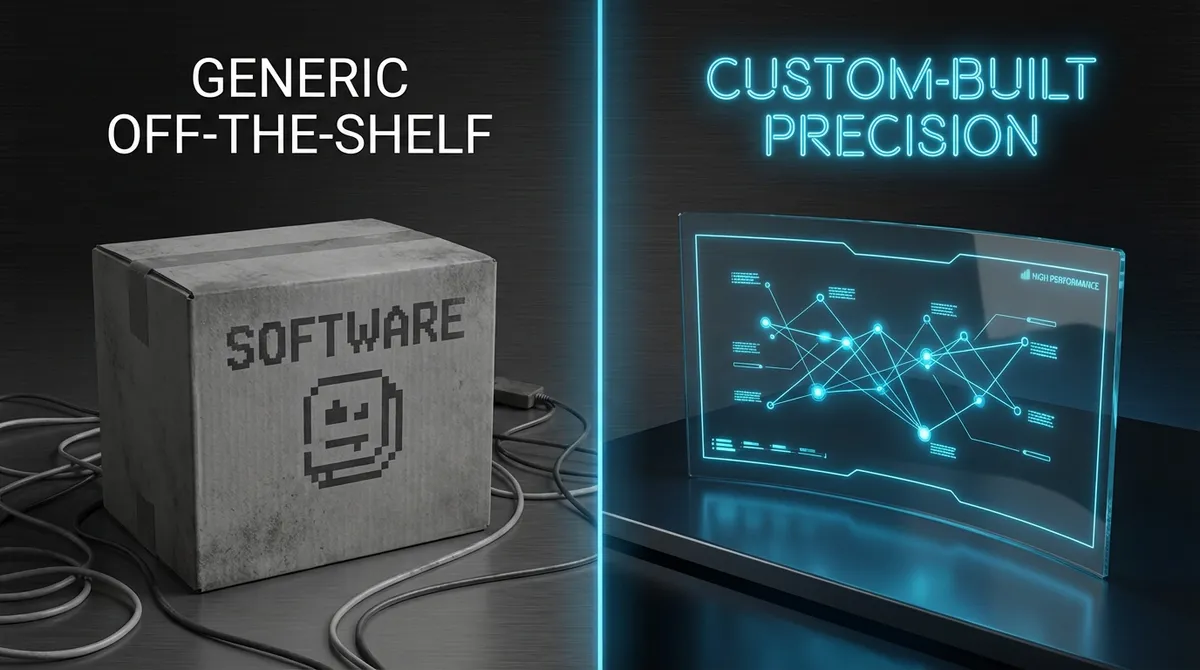
Every business starts with off-the-shelf tools. Spreadsheets, generic CRMs, whatever free plan gets the job done. That is fine until it is not.
The moment your process does not fit the software, you start bending your business to match the tool. And that is where things go wrong.
Key Takeaways
- Off-the-shelf software is built for the average user — if your business is specific, it will never quite fit
- Workarounds are a hidden productivity tax: small inefficiencies compound into weeks of wasted time per year
- SaaS subscription costs, seat fees, and integration add-ons often make bespoke software cheaper within 18 to 24 months
- Custom software is built around your workflow, not the other way around — it does exactly what you need and nothing you do not
- The right time to consider bespoke is when your team is spending more than a few hours a week on workarounds or data reconciliation
The Off-the-Shelf Trap
SaaS products are built for the average user. They need to work for thousands of different businesses, so they optimise for the middle. That means:
- Features you do not need cluttering the interface
- Missing features that would save you hours, but only affect your niche
- Monthly fees that creep up as you add users, seats, and integrations
- Vendor lock-in where your data lives in someone else's system
For a small business in Stoke-on-Trent running a specific type of operation, that "average" fit can mean hours of workarounds every week.
The Workaround Tax
Every workaround is a hidden tax on your team's productivity. Exporting data from one system, reformatting it in a spreadsheet, and importing it into another. Maintaining a separate spreadsheet alongside your CRM because the CRM cannot track the one metric you actually care about. Using a sticky note system for task handoffs because the project management tool does not support your workflow.
These workarounds accumulate. A five-minute workaround done three times a day, five days a week, adds up to nearly 65 hours a year. That is more than a week and a half of full-time work, spent doing something that software should handle for you.
And workarounds introduce errors. Every time someone manually copies data between systems, there is a chance they get it wrong. One transposed digit in a phone number, one missed email, one misattributed lead, and you have lost a customer. The cost is not just time. It is accuracy and reliability.
The Price Creep Problem
SaaS pricing is designed to grow with you, but not in a good way. You start on a free plan or a basic tier. Then you need an integration. That is a higher tier. Then you add three team members. That is per-seat pricing. Then you hit a data limit. That is another upgrade.
Before you know it, a tool that cost £20 a month is now £200 a month, and you are still working around its limitations. Multiply that across three or four SaaS subscriptions and you are spending thousands of pounds per year on software that does not quite do what you need.
We have seen businesses in Staffordshire spending more on their SaaS stack than a bespoke system would cost to build and maintain. And the bespoke system actually fits.
When Bespoke Makes Sense
Custom software makes sense when:
- Your workflow is unique - you have a process that no SaaS product handles cleanly
- You are scaling - what worked for five people breaks at twenty
- Integration matters - you need three or four systems talking to each other seamlessly
- Speed is critical - your team needs to do things faster than a generic UI allows
A bespoke system does exactly what you need and nothing else. No bloat, no compromises, no monthly per-seat charges that grow with your headcount.
Specific Scenarios Where Custom Wins
Scenario 1: The multi-step approval process. You run a construction company in Staffordshire. Every quote needs to be reviewed by the estimator, approved by the project manager, and signed off by the director before it goes to the client. No off-the-shelf CRM handles this exact workflow without significant customisation. A bespoke system handles it exactly the way your team works, with automated routing, reminders, and a clear audit trail.
Scenario 2: The hybrid product-service business. You sell products and provide installation services. Your inventory system does not talk to your booking system. Your booking system does not know what stock you have. Your invoicing splits product costs and labour costs differently. A bespoke system unifies all of this into one interface that shows your team everything they need.
Scenario 3: The data-driven operation. You run a recruitment agency. You need to match candidates to roles based on dozens of criteria, track the pipeline for each role, manage client relationships, and generate performance reports. Generic CRMs get you partway there, but the matching logic, the reporting, and the pipeline view all need to work your way. Custom software makes that possible.
Scenario 4: The regulated industry. If your business operates under specific regulatory requirements, off-the-shelf tools rarely cover compliance out of the box. A bespoke system can build compliance checks, audit logging, and required reporting directly into the workflow, so compliance is not an extra step. It is built into how you work.
What Modern Bespoke Looks Like
Custom software in 2026 is not the six-month, six-figure project it used to be. Modern frameworks and tools have dramatically reduced the cost and timeline:
- Next.js gives us a production-grade frontend in days, not months
- Vercel handles deployment, scaling, and global CDN without DevOps overhead
- AI integration means features that would have taken weeks to build, like search, classification, or content generation, can be added quickly using models like Claude
- Serverless architecture means you pay for what you use, not for idle servers
We can go from brief to working prototype in two to three weeks. That is faster than most SaaS onboarding processes.
The Modern Development Stack
Let me explain what this means in practice, because "modern development" can sound abstract.
Next.js is a React framework that handles both the frontend (what your team sees and interacts with) and the backend (the logic, data processing, and API connections) in a single codebase. This means we build faster and the result is more cohesive. It also means your application is fast. Server-side rendering, automatic code splitting, and optimised asset loading are built in.
Vercel is where we deploy. When we push a code change, it goes live within minutes. No server configuration, no deployment scripts, no downtime. If your system needs to handle ten users or ten thousand, the infrastructure scales automatically. And because Vercel runs on a global CDN, your application is fast from anywhere.
AI integration is where things get interesting. Features that would have required weeks of development three years ago can now be built in hours. Need your system to classify incoming enquiries by type? That is an AI model reading the text and assigning a category. Need to generate summary reports from raw data? AI handles it. Need a search function that understands what your team is actually looking for, not just keyword matching? AI again.
Serverless architecture means there are no servers to manage, patch, or pay for when they are idle. Your system runs on-demand. If it processes a hundred requests a day, you pay for a hundred requests. If it processes ten thousand, you pay for ten thousand. The scaling is automatic and the costs are predictable.
The Total Cost Comparison
People assume bespoke is expensive. But add up what you are paying for three or four SaaS subscriptions, plus the time your team spends on workarounds, plus the cost of data that does not flow between systems. Custom software often works out cheaper within the first year and it only gets more cost-effective over time.
Running the Numbers
Here is a realistic comparison for a mid-sized service business in Staffordshire:
Off-the-shelf stack:
- CRM: £80/month (4 users)
- Project management: £50/month
- Invoicing: £30/month
- Email marketing: £40/month
- Form builder: £20/month
- Integration tool (Zapier): £50/month
- Total: £270/month = £3,240/year
Plus the hidden costs:
- Time spent on workarounds: estimated 5 hours/week = 260 hours/year
- At £15/hour, that is £3,900/year
- Data inconsistencies and errors: hard to quantify but real
Total real cost of off-the-shelf: roughly £7,140/year, with limitations you have to live with.
A bespoke system that replaces this entire stack, built exactly for your workflow, with no per-seat charges, costs a one-time build fee plus a modest monthly hosting and support cost. After the first year, you are paying a fraction of the SaaS stack and getting a better result.
What You Own vs What You Rent
There is a philosophical difference too. SaaS software is rented. You pay monthly for access. If the vendor raises prices, changes features, or shuts down, you are stuck. Your data lives in their system. Your workflows depend on their decisions.
Bespoke software is yours. The code, the data, the design. If you want to change providers, you can. If you want to modify the system, you can. If the tool you depend on announces a 40% price increase (it happens more often than you think), you are not affected.
The Migration Question
"But we already have all our data in X system." Fair point. Migration is a real consideration, and it is one we handle carefully. We build data migration pipelines that move your historical data into the new system with integrity checks at every step. Nothing gets lost, and you have a transition period where both systems run in parallel so your team can verify everything before the old system is retired.
It is less disruptive than you might expect. We have migrated businesses in Stoke-on-Trent from legacy systems with years of historical data, and the transition typically takes a few days, not weeks.
Built in Staffordshire, for Staffordshire
At Denton Dynamics, we build bespoke software for businesses that have outgrown their tools. If your team is fighting the software instead of using it, that is a sign. We build systems that fit the way you work, using modern technology that is fast, reliable, and cost-effective.
We are based in Staffordshire. We work with businesses across Stoke-on-Trent and the surrounding area. We understand the local market, and we build with the practical mindset that the region is known for. No overcomplicated solutions. No enterprise bloat. Just software that does exactly what your business needs.
If your team is fighting the software instead of using it, let us build something that actually fits.
Nate Denton
CEO, Denton Dynamics
Nate is the founder and CEO of Denton Dynamics, an AI consultancy and software development agency in Stoke-on-Trent. He has been building AI automation systems, bespoke software, and SEO strategies for UK businesses since 2022. Every article on this blog comes from direct implementation experience. Read his full profile.
Trending
Related post
Expand your knowledge with these hand-picked posts.

AI Integration Services: What They Are and Why You Need Them
AI integration services connect your disconnected business tools into one automated workflow. Here is what that means in practice.
Nate Denton - CEO, Denton Dynamics

Business Process Automation: A Practical Guide for SMEs
Business process automation removes repetitive manual work. Here is how SMEs are using it, what to automate first, and how to get started.
Nate Denton - CEO, Denton Dynamics


Ready to Build Something That Actually Works?
We build real systems. AI automation, bespoke apps, websites that rank, and sales engines that run while you sleep. Book a call and let's talk.