
AI Sales Engines: Stop Losing Leads to Slow Follow-Up

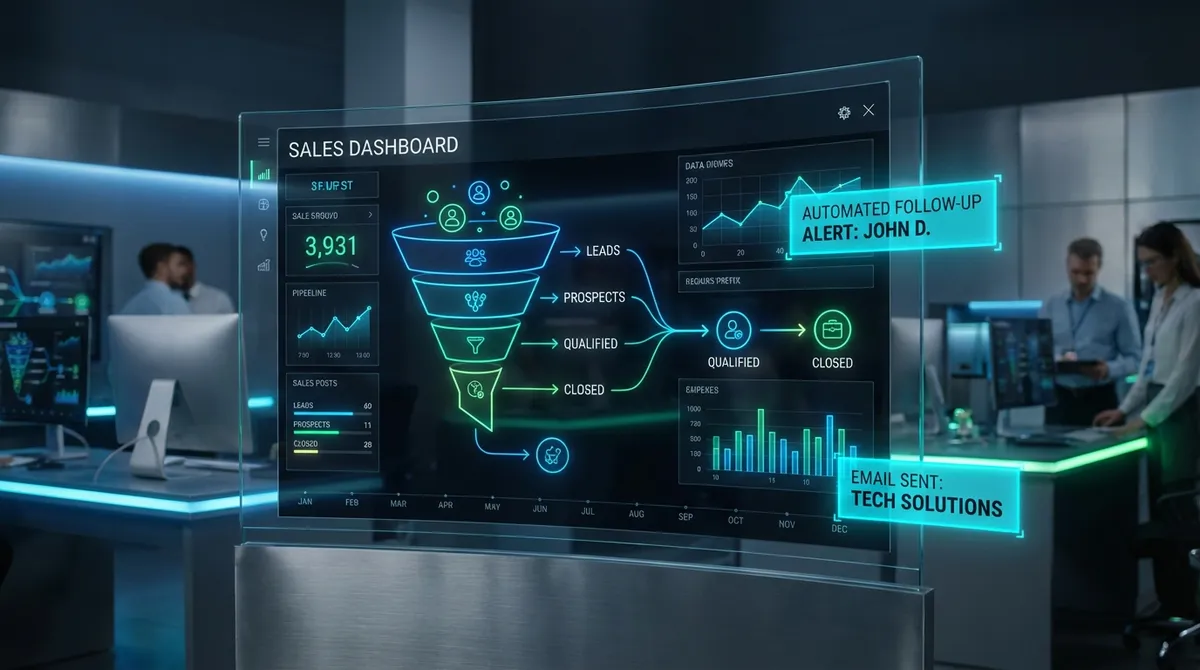
Here is a stat that should keep you up at night: the average business takes over five hours to respond to a new lead. By that point, the lead has already contacted your competitor, got a reply, and probably booked a call.
Speed kills in sales. And if you are a business in Stoke-on-Trent or anywhere in Staffordshire relying on manual lead follow-up, you are leaving money on the table every single day.
Key Takeaways
- The average business takes over five hours to respond to a new lead — by which point the prospect has already heard back from a competitor
- Speed of response is a proxy for quality of service in the customer's mind — it shapes buying decisions before you have said a word
- An AI sales engine handles capture, qualification, and follow-up automatically across every channel, from web forms to social DMs
- Automated nurture sequences keep leads warm without your team having to remember to follow up
- A well-built sales engine does not replace your salespeople — it means they only speak to leads that are ready to buy
Why Response Time Matters More Than You Think
There is research on this that consistently shows the same thing: the faster you respond to a lead, the more likely you are to convert them. The drop-off is steep. Responding within five minutes versus thirty minutes is not a marginal improvement. It is a dramatic one.
Think about your own behaviour as a consumer. You need a plumber. You search online, find three options, and send an enquiry to each. One replies in three minutes with a friendly, helpful response. One replies four hours later. One replies the next day. Who are you going with?
The first one. Almost always. Not because they are the best plumber, but because they demonstrated responsiveness. In the customer's mind, speed of response is a proxy for quality of service. If they are this fast to reply, they will probably be reliable when they actually do the work.
Now multiply that across every lead your business receives. If you are getting 20 enquiries a week and your average response time is three hours, you are probably losing half of them to faster competitors. An AI sales engine responds in seconds, not hours. That is the difference.
What an AI Sales Engine Does
An AI sales engine is not a CRM with some extra buttons. It is a system that handles the entire front end of your sales process:
1. Instant Capture
When a lead fills in a form, sends an email, or messages you on social media, the system captures their details immediately. No waiting for someone to check the inbox.
This sounds basic, but the reality is that most small businesses have leads scattered across multiple channels. A form submission sits in an inbox. A Facebook message sits in Messenger. A phone enquiry gets scribbled on a Post-it. An Instagram DM sits unread. Without a centralised capture system, leads slip through the cracks. It is not a question of if, but how many.
An AI sales engine consolidates all of these channels into a single pipeline. Every lead, regardless of where it comes from, enters the same system and gets the same treatment. Nothing is missed because someone was on their lunch break when the email came in.
2. Automatic Qualification
Not every enquiry is a good fit. AI can assess incoming leads based on criteria you define: budget, location, service type, urgency. High-priority leads get flagged instantly. Low-quality ones get a polite automated response.
Let me give you a concrete example. Say you run an IT services company in Staffordshire. You offer managed support packages starting at £500 per month. Half your enquiries come from individuals wanting help setting up their home Wi-Fi. Without qualification, your sales team spends time on every enquiry equally, regardless of whether it will ever become a customer.
An AI qualification system reads the enquiry, assesses the context, and scores it. A business enquiring about managed support for a 50-person office gets scored high and routed to your sales team immediately with a Telegram notification. An individual asking about home Wi-Fi gets a polite, helpful response pointing them to a more suitable provider. Your team's time is protected for the opportunities that actually convert.
The Scoring Model
AI qualification is not just about filtering out bad leads. It is about prioritising the good ones. A scoring model might consider:
- Service match. Is the customer asking for something you actually offer?
- Geography. Are they in your service area? For a Stoke-on-Trent business, a lead from Newcastle-under-Lyme is more valuable than one from Newcastle upon Tyne.
- Urgency signals. Words like "urgent," "ASAP," or "this week" indicate a hot lead.
- Budget indicators. The way someone describes their needs often signals their budget range.
- Company size. For B2B services, a larger company typically represents a larger opportunity.
The scoring model is configurable. You define what matters for your business, and the AI applies those criteria consistently to every lead.
3. Immediate Follow-Up
Within seconds of a lead coming in, they receive a personalised response. Not a generic "thanks for your enquiry" but an actual message that acknowledges what they asked for and tells them what happens next. AI models like Claude can generate these responses using context from the enquiry.
Here is the difference between a generic auto-reply and an AI-generated response:
Generic: "Thank you for your enquiry. We will be in touch soon."
AI-generated: "Hi Sarah, thanks for getting in touch about kitchen fitting for your property in Burslem. We have availability for a site visit this week. Our team will call you this morning to arrange a convenient time. In the meantime, you might find our recent kitchen renovation gallery helpful."
The second response demonstrates that you have read and understood the enquiry. It is personalised, specific, and sets an expectation. It builds confidence before your team has even picked up the phone.
4. Persistent Nurture
Not ready to buy today? The system keeps in touch. Automated email sequences, timed follow-ups, relevant content drops. All personalised, all automated, all tracked.
Most businesses have a "hot lead" process but no "warm lead" process. If someone enquires but does not convert immediately, they fall off the radar. Two months later, they are ready to buy, but they have forgotten about you. They search again, and this time your competitor responds first.
An AI nurture sequence prevents this. It maintains the relationship with relevant, useful touchpoints. Not aggressive sales emails. Helpful content, project updates, seasonal reminders. The kind of communication that keeps your brand top of mind without being annoying.
Nurture in Practice
A landscape gardening business in Staffordshire gets enquiries in January from people thinking about their garden for spring. Most of those enquiries are exploratory. The customer is not ready to commit yet. Without nurture, those leads go cold.
With an AI sales engine, each enquiry receives an immediate response, followed by a sequence of useful content: a guide to planning a garden redesign, a case study from a recent project in Stoke-on-Trent, an early booking offer for spring installations. By March, when the customer is ready to move forward, your business is the obvious choice because you have been helpful and present the entire time.
5. Handoff to Humans
When a lead is ready to convert, the system hands them to your sales team with full context: what they enquired about, what emails they opened, what pages they visited. Your team walks into the conversation fully briefed.
This is where AI sales engines transform the quality of human interactions, not just the speed. When your team picks up the phone, they know the customer's name, what they are looking for, how they found you, and what content they have engaged with. The conversation starts at a higher level. No "so, what can I help you with?" The customer feels known and valued. Your team feels prepared and confident.
Building the Pipeline Architecture
A well-designed AI sales engine is built in layers, and each layer is testable and improvable independently.
Layer 1: Capture. All inbound channels (website forms, email, social media, phone) feed into a single system. We typically use n8n for the orchestration layer, connecting sources to a central pipeline.
Layer 2: Enrichment. The raw lead data is enriched with additional context. AI reads the message to determine intent, urgency, and service type. If the lead is a business, the system can pull company information for additional context.
Layer 3: Qualification and Routing. Based on the enriched data, leads are scored and routed. High-priority leads trigger immediate team notifications via Telegram. Lower-priority leads enter an automated nurture sequence.
Layer 4: Response Generation. Claude generates personalised responses based on the enquiry context, your services, and your tone of voice. These responses are reviewed by the system for quality before sending.
Layer 5: Nurture Automation. Leads that do not convert immediately enter timed sequences. Content, follow-ups, and check-ins are scheduled and personalised based on the lead's interests and behaviour.
Layer 6: Handoff and CRM. When a lead is ready for a human conversation, the system creates a detailed brief in your CRM and notifies your team. All the context from layers 1 through 5 is available in one place.
Why This Matters for Local Businesses
Big companies have sales teams dedicated to this. They have SDRs, BDRs, and entire tech stacks. Small and mid-sized businesses in Staffordshire do not have that luxury. But with an AI sales engine, a team of three can compete with a team of thirty.
The playing field is not level in terms of headcount, but it can be level in terms of capability. When your lead response time, qualification accuracy, and follow-up consistency match a company ten times your size, you compete on what actually matters: the quality of your service.
What We Build
At Denton Dynamics, we build AI sales engines as custom systems, not off-the-shelf plugins. We integrate with your existing tools, deploy on fast infrastructure via Vercel, and use AI where it genuinely adds value: understanding enquiries, generating personalised responses, and automating the repetitive follow-up that your team never gets around to.
Every system is built to your specifications. Your scoring criteria, your tone of voice, your service areas, your process. The AI adapts to your business, not the other way around.
Measuring the Impact
Once your sales engine is running, the metrics tell the story:
- Average response time. Before vs after. This is usually the most dramatic improvement.
- Lead-to-conversation rate. What percentage of enquiries turn into meaningful conversations?
- Time to conversion. How long from first contact to closed deal?
- Lead source quality. Which channels bring the best leads? The data helps you allocate marketing budget effectively.
- Team time saved. How many hours per week does your team reclaim from manual follow-up?
We build dashboards that show these metrics in real time, built with Next.js and deployed on Vercel, so you always know how your pipeline is performing.
The Numbers
Businesses that respond to leads within five minutes are 100x more likely to connect. An AI sales engine gets you there without hiring a single extra person.
For a business in Stoke-on-Trent or Staffordshire, the maths is straightforward. If your average deal value is £2,000 and faster response time converts just two additional leads per month, that is £4,000 in extra revenue. Over a year, that is £48,000. The AI sales engine pays for itself many times over.
If your leads are going cold because your team is too busy to follow up, that is a fixable problem. Let us fix it.
Nate Denton
CEO, Denton Dynamics
Nate is the founder and CEO of Denton Dynamics, an AI consultancy and software development agency in Stoke-on-Trent. He has been building AI automation systems, bespoke software, and SEO strategies for UK businesses since 2022. Every article on this blog comes from direct implementation experience. Read his full profile.
Trending
Related post
Expand your knowledge with these hand-picked posts.
AI Integration Services: What They Are and Why You Need Them
AI integration services connect your disconnected business tools into one automated workflow. Here is what that means in practice.
Nate Denton - CEO, Denton Dynamics
Business Process Automation: A Practical Guide for SMEs
Business process automation removes repetitive manual work. Here is how SMEs are using it, what to automate first, and how to get started.
Nate Denton - CEO, Denton Dynamics


Ready to Build Something That Actually Works?
We build real systems. AI automation, bespoke apps, websites that rank, and sales engines that run while you sleep. Book a call and let's talk.